Advantages of Photovoltaic Cables
1、 Ultimate durability: Over 25 years of ultra long design life
Photovoltaic systems are typically guaranteed for 25 years, while the design lifespan of photovoltaic cables has reached or even exceeded this period. Ordinary PVC cables are exposed to sunlight, high temperatures, moisture, and chemical corrosion in outdoor environments, causing the insulation layer to become brittle and crack in a short period of time; Photovoltaic cables use irradiated cross-linked polyolefin (XLPO) as the insulation layer and sheath material. Through high-energy electron beam irradiation, covalent bonds are formed between molecular chains to form a stable three-dimensional network structure, completely changing the properties of the material
Rising heat resistance level: The irradiation crosslinking material increases the long-term working temperature of the cable from 70 ℃ of PVC to 120 ℃ (such as TC90 level in IEC 62930 standard), and the short-term temperature resistance can even reach 250 ℃. It can still stably carry current under high temperature conditions.
Strong UV resistance: the cross-linked structure, together with anti-aging additives such as special carbon black, can withstand UV radiation of more than 270kLy for decades, which is far higher than ordinary materials, and can cope with the harsh environment of desert, high altitude and other strong UV areas.
Resistance to environmental stress cracking: Cross linked materials have excellent resistance to cracking under the combined effects of high temperature, mechanical stress, and humidity, effectively ensuring the insulation integrity of cables throughout their entire lifecycle.
In terms of manufacturing process, high-quality photovoltaic cables adopt double-layer co extrusion one-time molding technology – the “inner insulation layer” focuses on insulation, and the “outer sheath layer” focuses on environmental erosion resistance. There is no gap between the two layers, completely preventing longitudinal penetration of water vapor or corrosive media, forming a multiple protection system.
2、 Ultimate safety: low smoke halogen-free and high flame retardant guarantee
Compared with ordinary cables, photovoltaic cables also have significant advantages in safety and environmental protection:
Low Smoke Zero Halogen (LSZH) Characteristics: Photovoltaic cables use low smoke zero halogen flame retardant materials, which will not release a large amount of toxic hydrogen halide smoke even in a fire. When it burns, the peak smoke density is ≤ 50%, and the release of halogen acid gas is ≤ 5mg/g, which complies with environmental and safety regulations. It is particularly suitable for enclosed spaces and densely populated places such as roof distributed photovoltaics and building integrated photovoltaics (BIPV).
High standard flame retardant performance: Photovoltaic cables must meet the strict requirements of EN 50618 standard. Taking the mainstream H1Z2Z2-K cable as an example, its flame retardant rating can reach the European Cca-s1a, d1, a1 levels, with no dripping and low toxicity during combustion, effectively curbing the spread of fire and buying valuable time for personnel evacuation.
Anti arc and high insulation strength: The insulation layer of photovoltaic cables has uniform thickness and high breakdown voltage resistance, with a volume resistivity of up to 1 × 10 ^ 14 Ω· cm and a stable dielectric constant of 2.3-2.5 (50Hz), which can effectively suppress leakage current and reduce DC transmission losses.
3、 Multiple conductor selection: Copper core and aluminum alloy each have their own advantages
Another core advantage of photovoltaic cables lies in their flexibility in conductor selection – the parallel development of copper core and aluminum alloy technology routes can achieve optimal matching according to project budget, installation conditions, and performance requirements.
(1) Tin plated copper conductor: ultimate conductivity and reliable connection
Tin plated copper conductors are the top choice for high-end reliability in photovoltaic cables
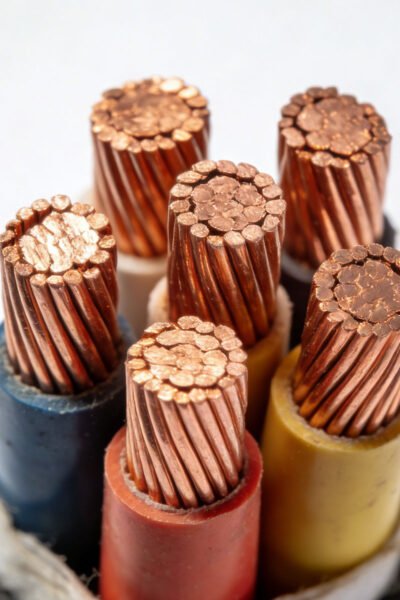
Excellent conductivity: Tin plated copper is made of oxygen free copper with a purity of ≥ 99.99%, which has extremely low resistance and can significantly reduce power loss during current transmission.
Strong antioxidant and corrosion resistance: A dense interface structure is formed between the tin plating layer and the copper substrate, which can effectively prevent the oxidation and sulfurization reaction of copper conductors under acid rain, salt spray, and humid air. This characteristic is particularly critical for harsh environments such as coastal areas, high humidity, and industrial pollution, as it can prevent local overheating and even fire hazards caused by poor contact.
Flexibility and fatigue resistance: After annealing treatment, tin plated copper conductors are soft and elastic. During the thermal expansion and contraction process caused by the temperature difference between day and night, the conductor is less prone to micro fracture due to fatigue, avoiding a sudden increase in local resistance.
(2) Aluminum alloy conductor: a green choice for cost reduction and efficiency improvement
With the increasing demand for cost control in the photovoltaic industry, aluminum alloy conductor photovoltaic cables are rapidly emerging as an ideal supplement to copper cables
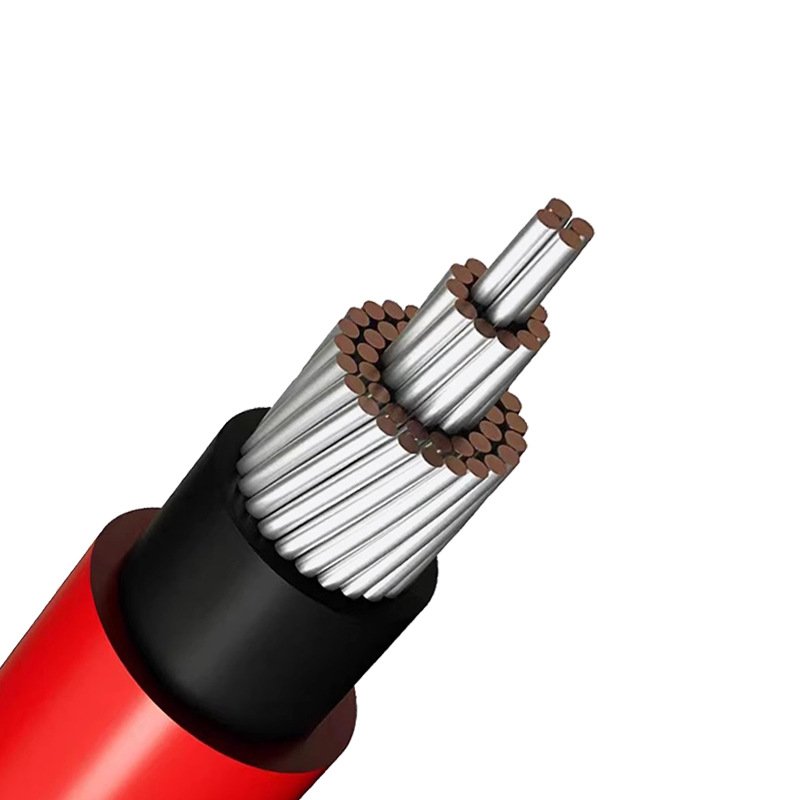
① Significant lightweight advantage: The density of aluminum alloy is only one-third of that of copper. Under the same current carrying capacity conditions (approximately 1.5 times the cross-sectional area), the weight of aluminum alloy cables is 50% -70% lighter than copper cables. The advantage brought by this feature is full chain: during transportation, each vehicle can carry longer cable lengths, reducing shipping costs; Construction site workers have easier operation and higher laying efficiency; When installed on the roof, it significantly reduces the building’s load-bearing burden, especially suitable for distributed rooftop photovoltaic projects.
② Significant cost savings: The price of aluminum is only 30% -50% of copper, and under the premise of equivalent performance, material costs can be reduced by 30% -50%. Taking a 100MW large-scale ground power station as an example, adopting the aluminum alloy cable scheme can save hundreds of thousands of yuan on cable investment alone. These saved funds can be reused to increase power generation components or improve system configuration, resulting in a better return on investment (ROI) for the power plant.
③ Excellent weather resistance and environmental adaptability: Aluminum alloy cables also use irradiated cross-linked polyolefin insulation and sheath materials, with a temperature resistance level of up to 120 ℃, excellent characteristics such as UV resistance, ozone resistance, acid and alkali resistance, and a service life of not less than 25 years. This makes it fully capable of handling various complex lighting scenarios such as outdoor roofs, high salt spray, and high altitudes.
④ Green and low-carbon attributes: From the perspective of the entire lifecycle, the carbon emissions from the production process of aluminum are about 70% lower than those of copper, which is more in line with China’s “dual carbon” goals and the EU’s strict requirements for the carbon footprint of photovoltaic products.
⑤ The connection technology and standards are becoming increasingly mature: In response to the technical pain points of electrochemical corrosion of copper aluminum dissimilar metals, the market has launched mature copper aluminum transition connector solutions. Through processes such as friction welding, poor contact between different metals can be effectively eliminated, and the contact resistance of the joint remains stable below 0.5m Ω for a long time. The electrical loss control is on par with copper cables and has been certified by T Ü V authority. At the same time, the national standard “Rated voltage 1.5kV DC cables for photovoltaic systems – Part 2: Aluminum alloy conductor cables” is being intensively formulated, laying a solid foundation for the standardized application of aluminum alloy conductor photovoltaic cables.
4、 An increasingly sophisticated system
Another key advantage of photovoltaic cables is their increasingly sophisticated and strict standard certification system, which ensures the consistency and universality of product performance
PV1-F (compliant with T Ü V 2PfG 1169 standard) and H1Z2Z2-K (compliant with EN 50618 standard) are the mainstream models, with a rated DC voltage of over 1.5kV, meeting the current demand of mainstream systems to upgrade to higher voltage levels.
China has also released multiple group standards related to photovoltaic cables, such as T/CSPSTC 145-2025 “Technical Regulations for Rare Earth High speed Railway Aluminum Alloy Cables for Photovoltaic Power Generation Systems”, which will be implemented in January 2025, covering the entire process of engineering design, construction and installation, and project acceptance. At the same time, standards such as T/CTBA 006.1-2025 Procurement Technical Review Guidelines have greatly improved the scientificity and reliability of the procurement process.
These standards require long-term thermal aging tests (simulating aging for thousands of hours at a high temperature of 135 ℃), acid alkali/salt spray tests, and rapid cold and hot cycle tests between -40 ℃ and+120 ℃ to ensure that the product has extremely high reliability under any extreme working conditions.
5、 Industry Trend: Rapid Growth of Photovoltaic Cable Market
The continuous expansion of installed capacity of photovoltaic systems is driving the astonishing growth of the photovoltaic cable market. Data shows that the global solar panel cable market is expected to reach a market value of 4.58 billion US dollars by 2025 and grow to 10.24 billion US dollars by 2032, with a compound annual growth rate of 12.17%.
The driving force behind this growth mainly comes from two directions: one is the development towards high voltage, with 1500V systems becoming mainstream, which puts higher demands on the insulation withstand voltage and current carrying capacity of cables; The second is the rapid popularization of aluminum alloy photovoltaic cables, which have brought significant economic benefits while ensuring system safety. They have been widely applied in large-scale projects such as Qinghai Ultra High Voltage Base, Guangxi, and Daqing in China, with a total of over 15000 kilometers of cables in operation.
It can be said that the photovoltaic cable market is in a dual dividend period of technological iteration and market expansion, providing increasingly diverse, reliable, and cost-effective solutions for power plant investors and operators.